I like Mansour Abbas. He has enormous intelligence, charisma, and charm. He likes good food, and he’s friendly and excellent at what he does.
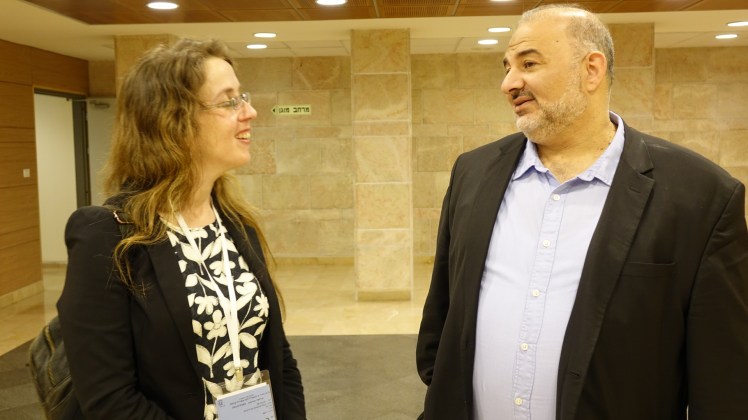
At the same time, there is a difference between the personal and the national. I know what he stands for.
The Muslim Brotherhood, the parent organization of Hamas, is outlawed in Egypt, Saudi Arabia, and the United Arab Emirates.
They understand how dangerous the Muslim Brotherhood is.
Ironically, horrifically (stupidly), in Israel, it is not. Here, it is called the Islamic Movement, and its activities are divided into two branches: northern and southern.
The northern branch was deemed an illegal organization due to its ties to terrorism. The southern version was not.
Ra’am is the political party associated with the Islamic Movement’s southern branch. The party’s leader, Mansour Abbas, is a brilliant man and has made the party enormously popular among Israeli Arabs.
In 2025, Abbas announced that he was severing ties with the religious leadership of the movement, the Shura Council. In Hebrew, he said that his goal was to focus on advancing the needs of the Israeli Arab population. Integration and equality were the top priorities.
Music to Western ears.
In Hebrew, he said that “Israel is the Jewish State.” An acknowledgement war-weary Israelis want to hear.
In Arabic, he said that “Israel is the Jewish State – for now.” Palestine has to wait, for now. The current task is to work on civic “rights,” from within, to achieve the desired changes.
Sabr. Patience. This is the principle that differentiates between the mindset of Islamists and that of Western people. The here-and-now isn’t what matters. The goal is what matters.
Names can change. Strategies can change. Different messages in different languages according to whatever is necessary to advance the goal.
The goal does not change.
On October 7th, Israeli Arabs were afraid to respond. What looked to be the downfall of the Jewish State unleashed a wave of Jewish wrath so great that patience seemed preferable to action. Better to go along. To be quiet.
The recent election cycle convinced Israeli Arabs that Israel’s wrath has abated, and so they responded – with democracy. They responded at the ballot box.
Israeli Arabs used their civil rights as Israeli citizens to an extent they never have before – winning 19 seats out of 120.
Leaders of the Arab Joint List, politicians who use different tactics than those of Abbas, dedicated the phenomenal results to the Arab prisoners in Israel’s prisons (i.e., terrorists and the invaders of October 7th), to Gaza, and to the goal of bringing down the Netanyahu government.
One might think they would be pleased with their newfound power and express eagerness to achieve better lives for Israeli Arabs. But that’s not the goal. Or, in a way, it is – they believe that when there is no more Jewish State, the “natural order” will be restored to the region, and the elections have given them a path forward.
So what does Israel do now?
Everyone is waiting with bated breath to see what will happen.
Despite October 7th and enormous amounts of money funding anti-Netanyahu campaigns, the Israeli opposition did not win enough mandates to form a government without the Arab parties. In fact, the election results show that anti-Netanyahu sentiment isn’t the sentiment of the majority of the Jewish population. It’s not even close to half.
But if you add the Arab vote, it becomes the majority.
So, does Israel’s left form a government with politicians who cannot denounce Hamas, support the October 7th invaders, and tell their public that “Palestine will have to wait – for now”? It seems utterly dystopian that a retired IDF Chief of Staff and numerous retired leaders of Israeli security services would even consider this possibility, but at the moment, they are – and the media is whitewashing reality to make it possible for them to do so.
The opposition campaigned against Netanyahu. They campaigned against the Orthodox Jewish parties. And they did it so well that they convinced themselves that sitting with brothers they don’t agree with is worse than sitting with the enemy that does not want us to exist.
One party from the opposition could offer to form a unity government with Netanyahu, whose Likud party won the majority of the votes. They could form a reasonable, sane(ish) government, leaving the Arab parties with their vast newfound influence in the opposition.
And even then, parties with large numbers of mandates have political clout and access to important positions and information. The leader of the opposition, for example, is entitled to secret service protection and security updates, including on pending strategic military actions.
Another option is to go to a second election cycle. If the opposition parties do not come to an agreement on forming a government with the Arab parties and refuse to participate in a right-wing government, new elections are a real possibility.
There is also evidence of voter fraud (although that doesn’t seem to be widespread) and foreign influence by Qatar that may have tipped the elections. It doesn’t seem that the impact of either of these was significant enough to go back to the ballot box, but who knows?
If new elections are called – due to issues of fraud or failure to form a government with the Arab parties – I expect that Israeli Arabs will be enraged. The riots of 2021 could look like a walk in the park. After all, they voted, legally and democratically. Throwing out their votes because of who they voted for is unacceptable.
And yet, the politicians they voted for are very dangerous.
And the fact that the voters know what those politicians stand for and chose them, in droves, is very dangerous.
And the Jewish voters who don’t listen to our neighbors and are blinded by names that have changed and words that are music to Western ears are, perhaps, the most dangerous of them all.
If you appreciate my writings and would like to support my efforts, please consider a PayPal donation to help me bring Inspiration from Zion to people around the world.

